No damage to the finish
Low pressure means the render, paint or cladding survives the clean instead of being part of what comes off.
Get the green off your walls without blasting the finish off with them: low-pressure cleaning that kills the growth at the root and leaves the surface it was applied to intact.
17 years' property experience · Lerwick-based team · Free, no-obligation estimate
17 years' experience
In Shetland property
Shetland & Orkney
Lerwick-based team
Mon–Fri, 9am–5pm
Local office hours
Rated on Google
Read our reviews
Overview
Softwashing cleans a surface using a purpose-made cleaning solution applied at low pressure, rather than relying on the force of water. The product does the work: it breaks down algae, lichen and organic staining and kills the growth at the root instead of simply knocking the top off it.
It is the correct method for anything that a pressure washer would damage: render, roughcast, harling, painted masonry, timber and composite cladding, uPVC, conservatory roofs and surface-sensitive roof coverings.
Because the growth is killed rather than blasted away, softwashed surfaces typically stay clean noticeably longer than pressure-washed ones, where the spores left behind start regrowing immediately.
Getting the dilution, dwell time and coverage right is what makes softwashing work. Too weak and nothing changes; wrong product for the surface and you have a different problem.
Surrounding planting, drainage, glazing and neighbouring property all need protecting and managing during the work; that is a large part of doing this job properly.
We match the method to the substrate. Not every surface should be softwashed, and not every surface should be pressure washed; knowing which is which is the service.
What It Costs To Ignore
Algae and lichen on a wall are not just a colour problem. They hold moisture against the surface, and a render or masonry face that stays permanently damp deteriorates: the finish breaks down, hairline cracks open up, frost gets into them and sections start to blow.
Once render begins to fail, the cost moves from cleaning to repair, and repaired render rarely matches the original. Painted surfaces go the same way: growth lifts the coating, moisture gets behind it and the paint film fails in patches.
The most expensive mistake, though, is the pressure washer. It is quick and it looks satisfying, and on render it drives water deep into the wall, opens up the surface and can strip roughcast off in sheets. We are regularly asked to look at walls where the cleaning caused more damage than the growth ever would have.
Our Process
We identify the substrate, the type of growth and the condition of the surface, and check what is causing the wall to stay damp in the first place.
We confirm softwashing is the right method, explain what result to expect, and give you a firm price.
Planting, paths, glazing, drainage and anything else at risk is protected before a drop of product is applied.
Cleaning solution is applied evenly at low pressure across the elevation and given the dwell time it needs to work through the growth.
The surface is rinsed down at controlled pressure and checked elevation by elevation, with any stubborn areas re-treated.
Site cleared and tidied, and anything we noticed, failed render, an overflowing gutter, rotten timber, reported to you honestly.
Benefits
Low pressure means the render, paint or cladding survives the clean instead of being part of what comes off.
Killing the growth at the root slows regrowth far more than blasting the surface clean and leaving the spores.
Render, timber, uPVC, glass and coated roofing can be treated on one property with the right approach on each.
Protection of planting, drainage and neighbouring property is planned before the work, not apologised for after it.
If painting is next, a softwashed surface gives the coating something clean and stable to bond to.
Persistent green usually means persistent water. We will tell you where it is coming from.
In Detail
Pressure washing removes material by force. On hard, durable surfaces such as concrete and stone paving that is exactly what you want, and we use it there.
Softwashing removes growth chemically at low pressure. On anything with a finish, render, paint, coating, timber, plastic, that is the only sensible approach, because force cannot tell the difference between the growth and the surface it is sitting on.
The practical difference shows up over time as well. A pressure wash leaves the root structure in place and the green returns quickly; a softwash kills it, so the surface stays clean for longer.
Persistent humidity, wind-driven rain and long damp spells give algae close to ideal conditions, and exposed weather elevations take the worst of it. North-facing walls that never fully dry out are usually the first to colour up.
Salt and grit carried on the wind add to the deposit on the surface, and any wall being repeatedly wetted by an overflowing gutter or a failed downpipe will stay green no matter how often it is cleaned. That is why we look at the drainage as part of the job.
On houses this is typically a one to two day job with an immediate visible difference across the whole property, and it is often combined with gutter clearing or a roof clean while access is already set up.
On commercial premises, softwashing keeps a building presentable to customers without closing anything down, and work can be scheduled around trading hours. For let property, it is one of the most cost-effective ways to lift how a whole building presents between tenancies.
Softwashing needs the product to stay on the surface long enough to work, so driving rain in the middle of an application is unhelpful. We plan work against the forecast and would rather move a day than get a poor result.
It also pays to think about sequence. If the roof is due a clean, that comes first, because everything washed off a roof runs down the walls. Gutters are cleared at the same time for the same reason, and the walls are treated last so the finished result is the one you keep.
Our Work
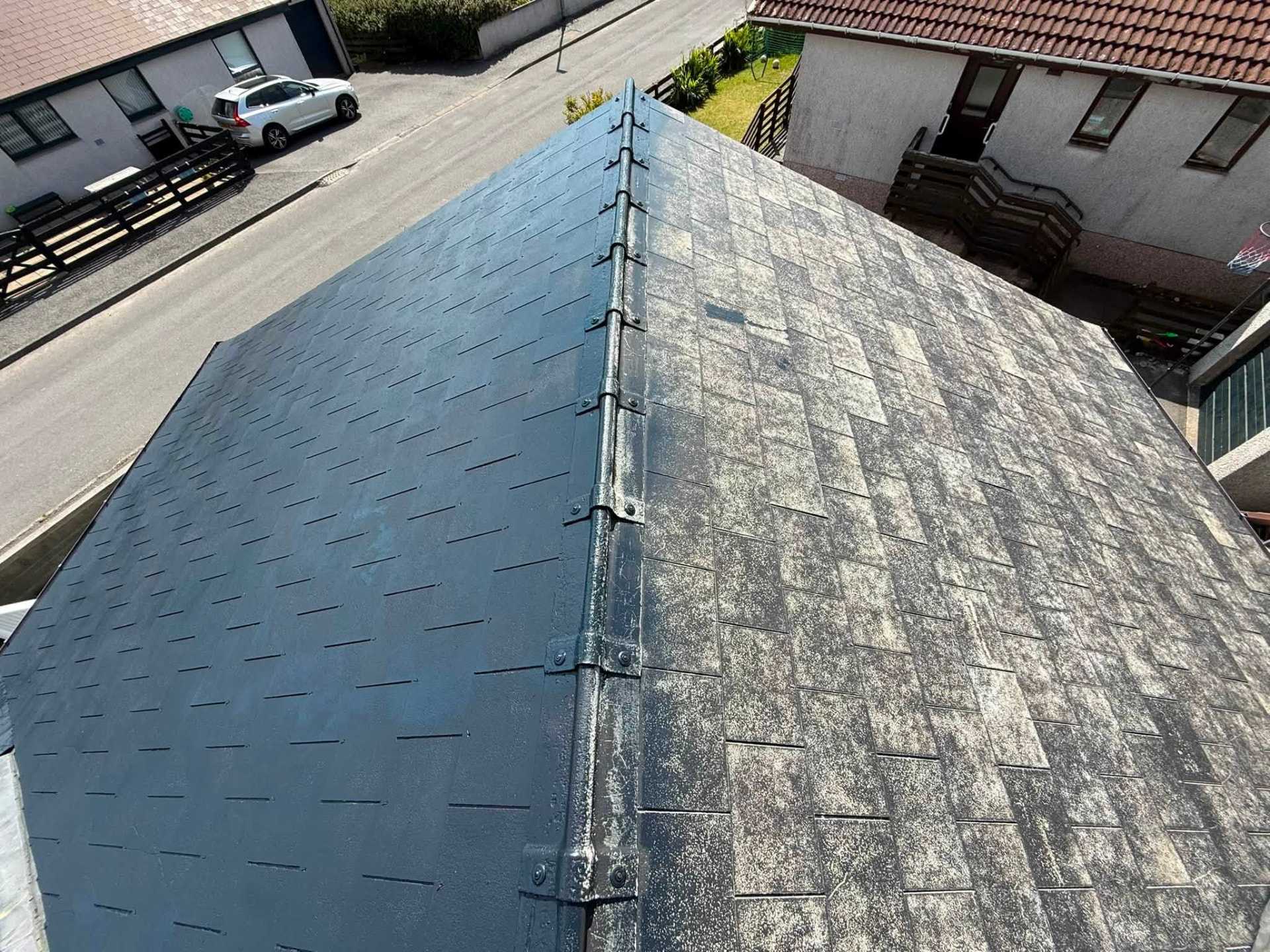
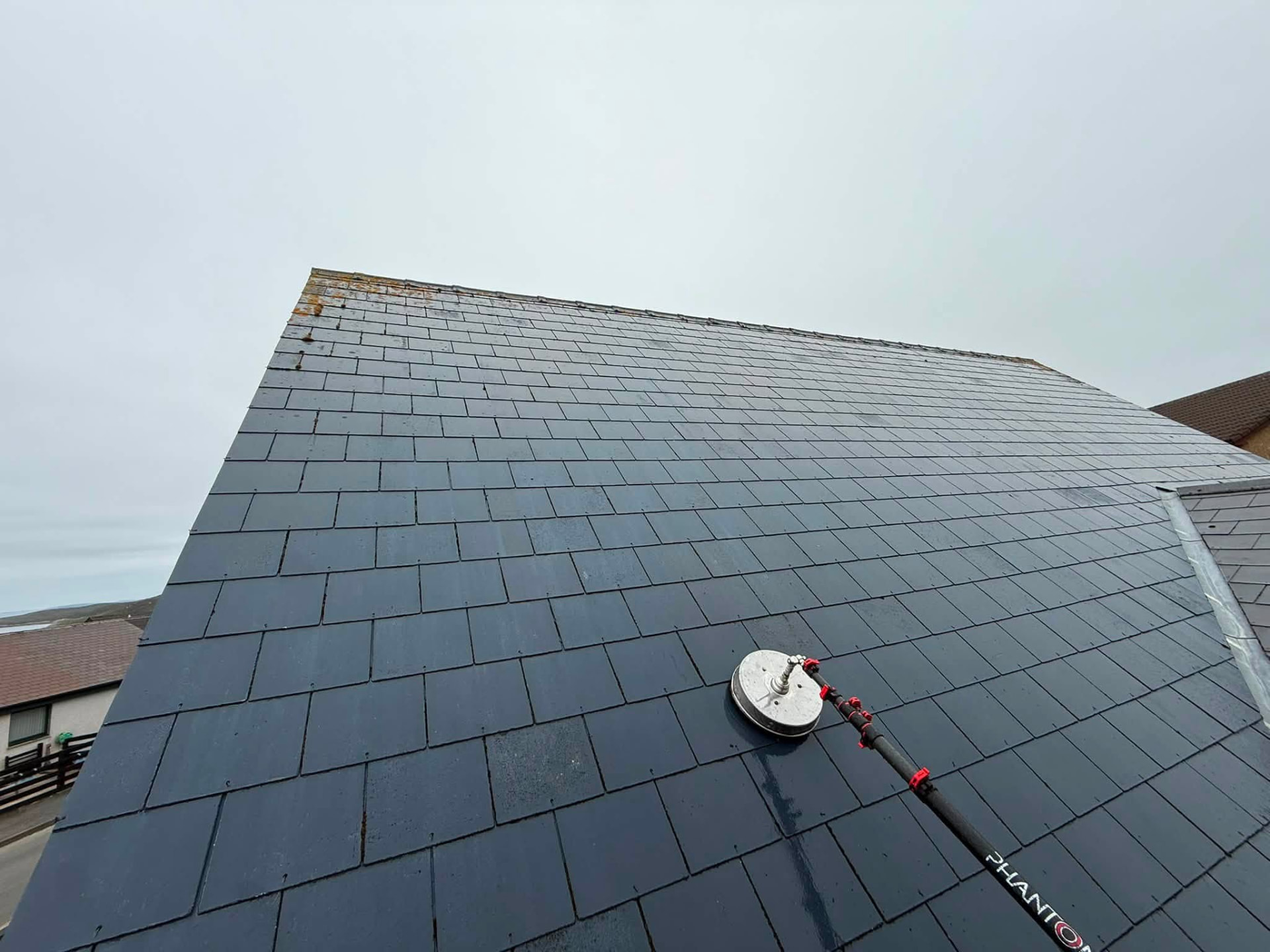
Photographs from our own jobs on Shetland properties, no stock images.
Where We Work
We are based on Commercial Street in Lerwick and travel across both island groups for cleaning and maintenance work.
More detail on the areas we cover is on the homepage areas section.
Questions
It depends on the size of the property, the number of elevations, the surface type and access. We look at the building and give you a clear price before any work starts, free and with no obligation.
Yes; that is precisely why it exists. The cleaning is done by the product at low pressure rather than by force, so the finish stays on the wall instead of coming off with the growth.
Longer than a pressure wash, because the growth is killed at the root rather than knocked off the surface. In this climate regrowth is eventually inevitable, and we will give you a realistic expectation for your property.
We protect planting, paths and drainage before starting and manage the rinse, which is a normal part of the job rather than an extra.
Most domestic properties are completed in one to two days depending on size and access. We confirm the expected duration when we price the work.
Yes. Glazing, uPVC, fascia, soffit and guttering all clean up well at low pressure and are frequently done at the same time as the walls.
Yes. Paint applied over algae or organic contamination fails early. A clean, stable surface is the difference between a coating that lasts and one that flakes.
Yes. We are based in Lerwick and cover the Shetland Islands and Orkney, including Kirkwall, Stromness and St Margaret's Hope.
Something is keeping it wet: usually a blocked gutter, a leaking joint, a failed downpipe or splash-back at ground level. Cleaning alone will not fix that, so we look for the cause and tell you what we find.
Related Work
Free Estimate
Tell us about the property and what the walls look like. We will assess the surface, confirm the right method and give you a firm price: free, with no obligation.
property@arthurandsimpson.com
68 Commercial Street, Lerwick, Shetland ZE2 9EZ
Mon–Fri, 9am–5pm · Closed Sat & Sun
17 years' property experience · Lerwick-based team · Free, no-obligation estimates